
⏱ Estimated reading time: 8 min read
On pleasure, performance, and learning to recognize your own taste.
Before you have even booked the restaurant, you can already picture yourself there.
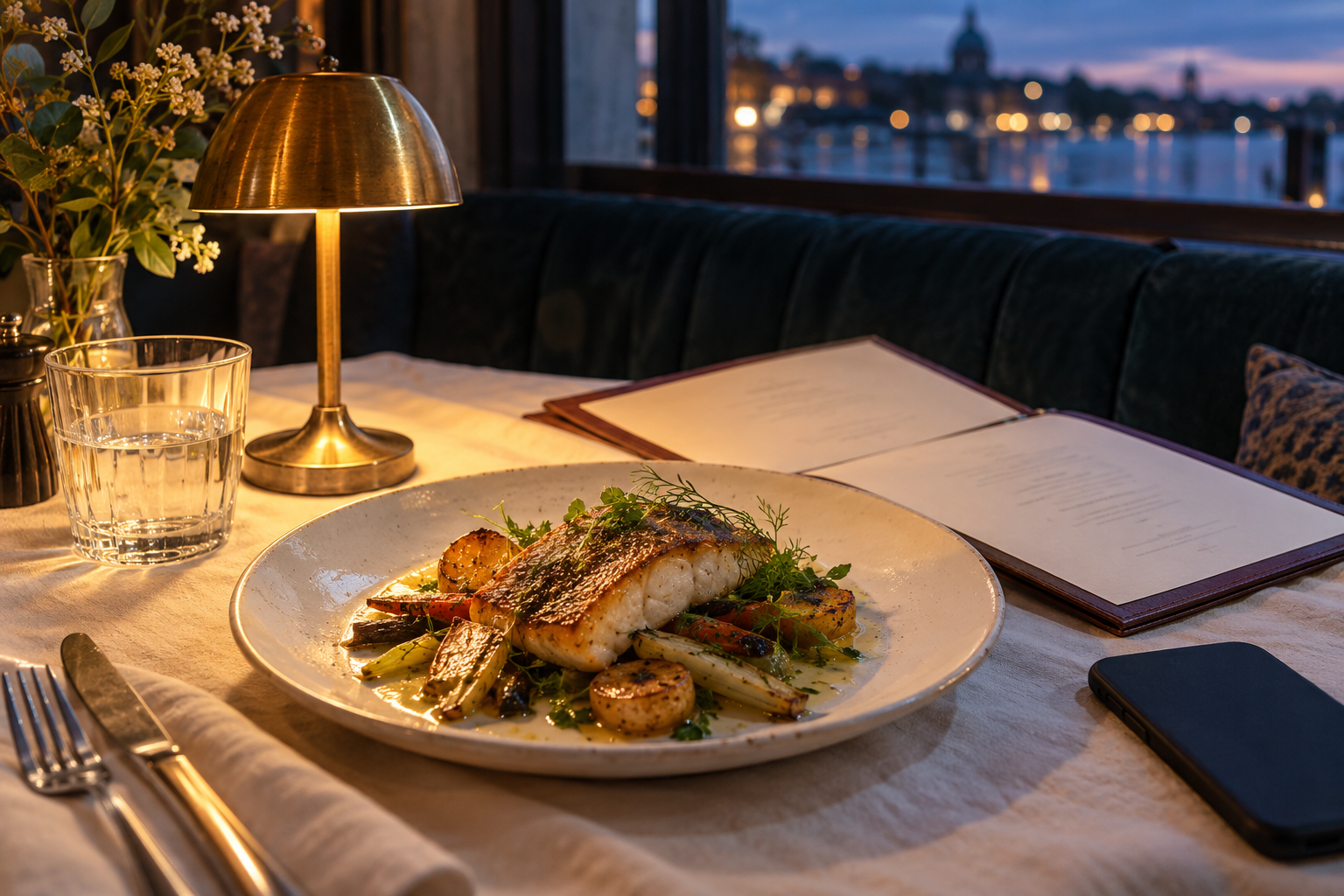
You know what you would wear. You have noticed the lighting, the glasses, the small lamp on the table. You can imagine the photograph. Somewhere in this arrangement, there is presumably dinner.
That does not mean you will dislike the food. You might love it. But it raises a question worth sitting with: which part of the experience are you looking forward to—the experience itself, or the version of you it makes available?
The distinction is rarely clean. We can genuinely enjoy something and enjoy what it says about us. A beautiful coat can feel wonderful to wear and make us feel more composed walking into a room. A book can hold our attention and please us when someone notices it on the shelf.
I do not think taste needs to be innocent of all social motives. I am more interested in what happens when the imagined audience becomes so influential that we stop consulting the person who will actually have to live with the choice.
The life inside the picture
Some things are easier to desire in a picture than in a day.
A spare, immaculate room may appeal to you until you discover how little you enjoy living without your books and familiar objects nearby. A packed itinerary may look like a rich experience of a city while leaving you too tired to notice much of it. An outfit may express exactly the woman you want to be, provided that woman never needs to sit down.
The picture omits the practical conditions of enjoyment. It cannot tell you whether the chair supports your back, whether the restaurant is too loud for conversation, or whether you spend the entire evening adjusting a neckline you liked much better on someone else.
None of this makes beauty unimportant. It makes the experience of beauty more demanding than its acquisition.
There is a difference between admiring a life and wanting to inhabit its ordinary hours. When we confuse the two, we can become very good at selecting things that represent us and surprisingly poor at selecting things that please us.
Sometimes we want the identity first
The result may be a collection of individually lovely choices that do not quite add up to a life we enjoy.
A preference can arrive with an attractive identity attached.
The person who reads that novelist. The woman who stays in that hotel. Someone who knows which wine to order, which designer to recognize, which small restaurant to recommend.
There is a promise in these identities: choose this, and you might become more interesting, more cultivated, more at ease. They offer a little help with the unfinished business of deciding who we are.
I do not want to dismiss that impulse. Aspiration can introduce us to things we eventually love. You might first attend a concert because you admire someone who goes, then discover that the music matters to you independently. You might buy a jacket for the confidence you associate with it and gradually learn what you appreciate about its construction.
An imperfect motive does not invalidate a real discovery.
The audience does not have to be online
The trouble begins when we become more loyal to the identity than to our experience. We insist that we enjoyed the book because we want to be the kind of person who enjoys it. We return to the restaurant because it is where someone like us would go, although we felt more comfortable and ate better elsewhere.
At that point, our preferences become obligations. We are maintaining a character whose tastes we may not share.
It is tempting to blame all of this on social media, but a preference can be performed for a room of four people.
It can be performed for a partner, a professional circle, an old classmate, or someone whose approval still matters more than we would like. Sometimes the audience is imaginary: a sophisticated stranger who might notice our purchase and understand, without any awkward explanation, exactly what kind of person we are.
Even privacy does not entirely remove the performance. We can buy something nobody else will see because possessing it reassures us about ourselves.
This is why “Would I still want it if nobody knew?” is a useful question, but not a final verdict.
What, specifically, do you like?
A dress intended for a celebration belongs to a social experience. Wanting to look beautiful in it is part of the pleasure, not evidence against it. Sharing a meal or recommending a book can deepen enjoyment. There is no special virtue in keeping everything you love to yourself.
The question is whether visibility adds to the pleasure or has quietly become a requirement for it.
If an evening feels wasted because you did not get a good photograph, something has shifted. If you lose interest in an object as soon as it becomes too familiar to impress anyone, it may have been doing a different job from the one you thought you bought it for.
One of the most revealing things you can ask about a preference is also one of the simplest: what do you like about it?
Not who makes it. Not how difficult it is to obtain. Not who else has one.
What happens when you encounter it?
Perhaps the fabric falls in a way that makes you feel comfortable and beautifully dressed at once. Perhaps the writer notices something you had experienced but never managed to put into words. Perhaps the restaurant gives you enough space and time to enjoy the person across from you.
Refusing the approved version of yourself
Specific answers bring us closer to the thing itself.
They also make disagreement less threatening. If you know why you enjoy something, another person’s indifference does not have to undo the experience. They may find your favorite room too dark or your preferred perfume too warm. You can consider their response without treating it as a correction.
And sometimes there is no articulate explanation. You simply want to hear the song again. That counts too. Taste is not an examination in which every pleasure needs an impressive defense.
In fact, an inability to explain a preference elegantly may be less concerning than having a perfect explanation for something you never actually reach for.
There is a particular freedom in admitting that something admirable is not for you.
The preferences that survive use
Not bad. Not overrated. Not evidence that everyone who enjoys it is pretending. Just not yours.
That last distinction matters. Discovering your own preferences does not require making other people’s pleasures look foolish. You can dislike a celebrated book without diagnosing its readers. You can enjoy an unfashionable restaurant without turning your choice into a declaration of superior authenticity.
Rejecting everything popular can become another performance. So can making simplicity a badge of refinement. The audience is still directing the choice; you have merely learned to impress it through refusal.
I would rather leave room for inconsistency. A person can appreciate careful tailoring and love a ridiculous television show. They can enjoy an expensive hotel and prefer the inexpensive meal around the corner. They can care deeply about beautiful objects without needing every object they own to contribute to a coherent public identity.
A life is allowed to contain pleasures that would confuse its mood board.
Perhaps the most trustworthy evidence of taste is what happens after the introduction.
What do you wear once the novelty has passed? Which places do you return to when you are not bringing someone you want to impress? What do you keep enjoying after you have stopped explaining it?
Repeated use gives a preference substance. The shoes acquire creases. The book becomes something you argue with rather than display. The restaurant becomes familiar enough that you no longer need the evening to prove anything.
Some things lose their appeal under these conditions. Others become more valuable.
That is useful information, even when it is inconvenient. Especially when it is inconvenient.
I want to leave room for taste to change through contact with an actual life: through wearing, reading, visiting, noticing, and occasionally admitting that I wanted the idea more than the thing.
There will still be photographs. There will still be beautiful choices, aspirations, and the pleasure of being seen. None of that needs to disappear.
But before booking the table, it is worth looking at the menu.
You are the one who will be eating dinner.
Leave a Reply